

If you have ever pasted a sentence into a translate app before messaging a stranger in another country, ordering food on a trip abroad, or reading reviews on a website in a language you don’t speak, you have already used AI translation. It is one of those technologies that quietly works in the background of daily life, running alongside all the other invisible tech, like smart sensors and connected devices, that most people never think twice about.
But “AI translation” gets thrown around a lot, and it is not always clear what makes it different from the machine translation people have used for the last twenty years. In this guide, we will break down what AI translation actually is, how it works under the hood, why it is not always perfect, and where the technology is headed next.
Table of Contents
What Is AI Translation?
AI translation is the use of artificial intelligence, specifically machine learning models trained on huge amounts of text, to convert words and sentences from one language into another automatically.
Unlike the phrasebook style translation of the past, AI translation systems do not just swap word for word. They try to understand the meaning, tone, and context of a sentence before producing an equivalent in the target language. That is why a good AI translation of a joke, an idiom, or a piece of marketing copy can sound natural instead of robotic.
How Does AI Translation Work?
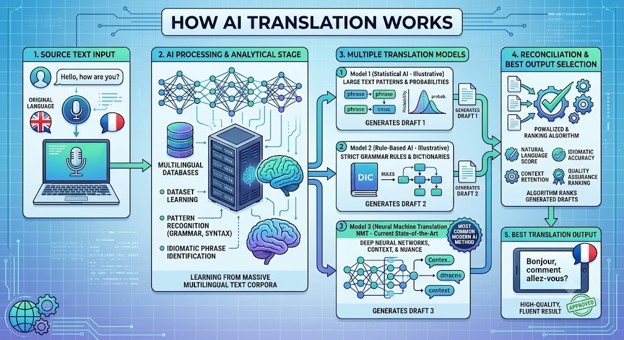
Most modern AI translation runs on something called neural machine translation, or NMT. Here is the simplified version of how it works:
- The system is trained on millions of sentence pairs in different languages, learning patterns in grammar, word order, and meaning
- When you type a sentence, the model breaks it down into smaller pieces and analyzes the relationships between words
- Instead of translating word by word, it considers the entire sentence, and often the surrounding paragraph, to figure out the most accurate meaning
- It then generates a new sentence in the target language that aims to preserve that meaning, not just the literal words
This is why modern AI translation can usually tell the difference between “I’m going to the bank to deposit a check” and “I’m going to sit by the river bank,” even though the word “bank” is identical in both.
How Is It Different from Traditional Machine Translation?
Older machine translation tools relied on rule-based or statistical methods. Rule-based systems used dictionaries and grammar rules written by linguists. Statistical machine translation looked at how often certain word combinations appeared together in large volumes of translated text.
Both approaches struggled with context, and both tended to produce translations that were technically correct but read strangely.

Neural machine translation, and the newer large language model based translation that has emerged in the last few years, handles context far better because it looks at meaning across the whole sentence rather than isolated word pairs.
Why Businesses and Individuals Use AI Translation
The reasons people reach for AI translation go well beyond convenience.
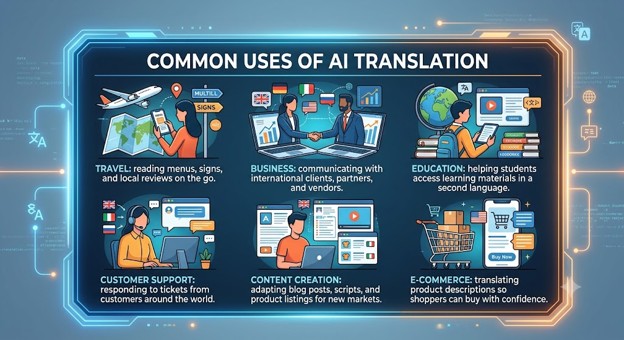
That last point matters more than people realize. According to a CSA Research survey of 8,709 consumers across 29 countries, 76% of online shoppers prefer to buy products with information in their native language, and a notable share said they will never buy from a website in a different language. For any business selling internationally, that is not a nice to have. It is a conversion problem.
AI translation is not limited to text either. Readers who have looked into AI voice tools, like the text to speech and voice cloning features covered in our guide to UberDuck AI, will recognize a similar pattern: AI models trained on huge datasets, applied to language, at a scale no human team could match manually.
Can AI Translate Every Language Perfectly?
Not even close, and this is where a lot of beginners get surprised.
AI translation quality depends heavily on how much training data exists for a given language pair. Widely spoken languages with huge amounts of digital text, like Spanish, French, or German, tend to translate more reliably than lower resource languages with less available data.
There is also a structural reason this problem will not disappear soon. Roughly half of all identifiable website content is still published in English, which means AI models simply have far more English language material to learn from than they do for many other languages. Idioms, humor, regional slang, and highly technical or legal language remain the hardest categories for any single AI model to get consistently right.
This is also where a deeper problem shows up: different AI models often disagree with each other. Ask three different AI models to translate the same sentence and it is common to get three different answers, especially on anything involving tone, ambiguity, or specialized vocabulary. Trusting a single model means trusting whichever answer it happens to land on, with no way to know if that answer was the strongest choice available.
Modern AI Translation Platforms
This disagreement problem is part of why some newer AI translation platforms have moved away from relying on just one AI model. Instead of picking a single system and hoping it gets the sentence right, these platforms run the same text through several different AI models at once, compare the results, and select the version that the most models agree on.
MachineTranslation.com is an example of an AI translation platform built around this approach. Rather than betting on one model’s interpretation of a sentence, it uses its SMART mechanism to evaluate the source context and compare output across 22 AI models simultaneously, selecting the translation the majority agrees on. This reduces the kind of one-off errors and inconsistent word choices that can happen when a single model is left to make the call alone.
For everyday users, the practical upside is straightforward: it is one more layer of checking built into the process, rather than needing to manually copy the same sentence into several different translation apps and compare the results yourself.
Final Thoughts
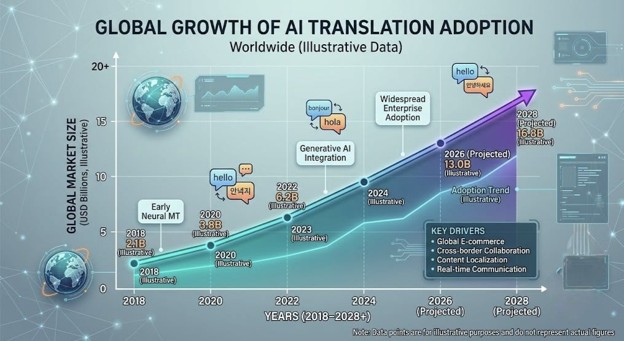
AI translation has come a long way from clunky word-for-word substitutions. Neural networks, huge training datasets, and now multi-model comparison approaches have made automatic translation more context aware and more reliable than it has ever been.
That said, no AI translation system, single model or multi-model, is a perfect replacement for a professional human translator when the stakes are high, such as legal contracts or medical documents. For everyday use, though, from travel to customer support to content creation, AI translation has become a genuinely useful part of how people communicate across languages, and it is only getting better as the underlying models improve.
Frequently Asked Questions
What is AI translation?
AI translation is the use of machine learning models, trained on large volumes of text, to automatically convert language from one language to another while trying to preserve meaning and context rather than translating word for word.
How accurate is AI translation?
Accuracy varies by language pair and content type. Widely spoken languages with large amounts of training data tend to translate more reliably, while idioms, slang, and highly technical or legal text remain more difficult for AI systems to handle consistently.
Can AI translate all languages equally well?
No. AI translation quality depends on how much digital text exists for a given language to train on. Languages with less available data, sometimes called low resource languages, generally see lower translation accuracy than widely spoken languages like Spanish or French.
Is AI translation the same as Google Translate?
Google Translate is one well known example of an AI translation service, but it is not the only one. Other platforms use different approaches, including comparing results across multiple AI models rather than relying on a single system.
Will AI translation replace human translators?
Unlikely in the near term, especially for high stakes content like legal, medical, or highly creative material. AI translation is better understood as a tool that handles everyday translation needs efficiently while human translators remain essential for nuanced or high risk work.